
Five worlds,
150 puzzles
Piradoku takes you on a voyage across five worlds of thirty puzzles each. The basic rule never changes: draw the one route from your ship to the treasure, so that every number on the edge fits. What changes is the water, the islands, the pieces on the board and one extra rule per world that asks you to think in a new way.
You start on the open sea, where the boards are small and the rule is pure. Once you have solved all thirty puzzles of a world, the next one opens on the map, a little further along the dotted line. A world that is still locked shows its island with a padlock, so you can see where you are heading but not what waits there.
The sea
30 puzzles, boards from 5 by 5 to 7 by 7 squares
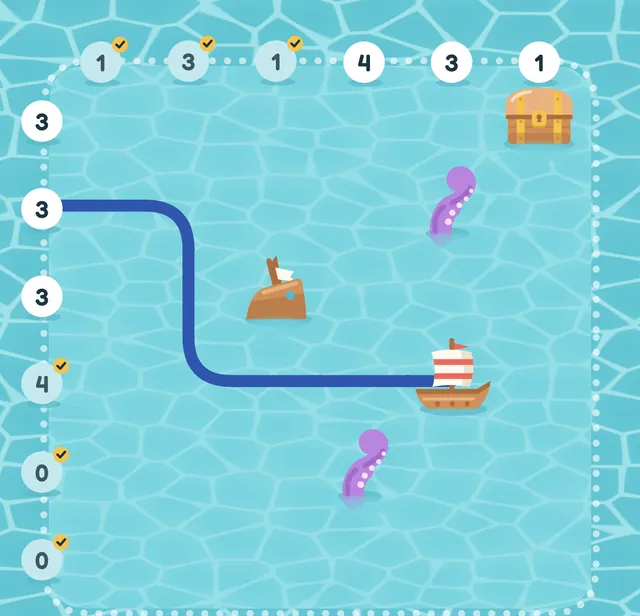
The first world is a sunny stretch of open water with sandy islands and an old wreck on the map. Here you learn the language of the game: the ship, the treasure, the numbers on the edge and the pieces that block your way. Rocks, wrecks and the curling tentacles of something that lives under the waves each fill one square, and your route can never pass through them.
The first boards are five squares wide, so you can take in the whole puzzle at a glance. As you sail on they grow to six and then seven squares, and the routes get longer and more winding. By the end of the sea you read a row of numbers the way a sailor reads the wind.
The rule
Follow the numbers. Each one says how many squares of its row or column your route uses. The route goes from square to square, never diagonally, and never visits the same square twice.
Tips for this world
- Start with the zeros: put a cross in every square of a row or column with a 0.
- A number that equals the open squares in its row fills that row completely.
- Rocks and wrecks squeeze the route, so look at the squares around them first.

The ice sea
30 puzzles, boards of 6 by 6 and 7 by 7 squares
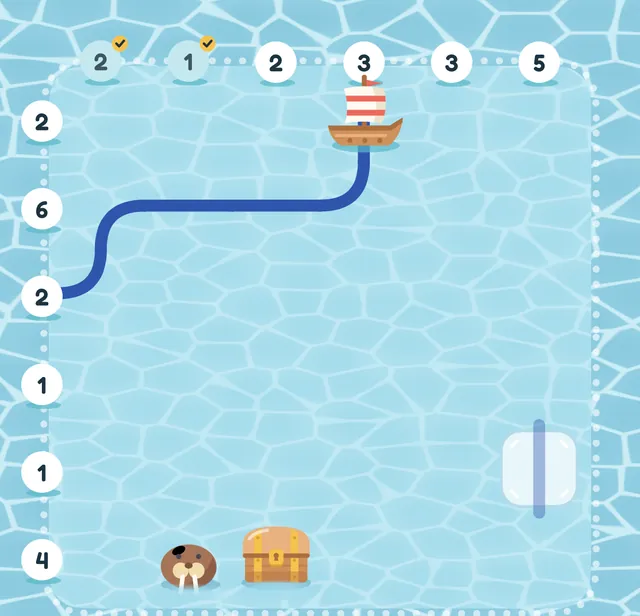
In the second world the water turns pale and cold. Ice floes and icebergs block the way, and a walrus dozes on the ice, watching your ship drift by. The boards start at six squares wide and soon grow to seven.
Here the game hands you something new: frozen pieces of route. They are already on the board when you start, and they show exactly how your ship must pass that square.
The rule
A frozen piece of route is a square your ship must pass through, coming in and going out on the sides the piece shows. It is part of the solution, so use it as a firm starting point and work outwards from both of its ends.
Tips for this world
- Extend a frozen piece first: its two open ends tell you where the route goes next.
- Count the frozen squares when you check a row, because they already use up part of its number.
- Two frozen pieces close together often have only one way to connect.

The volcano island
30 puzzles, boards of 6 by 6 and 7 by 7 squares
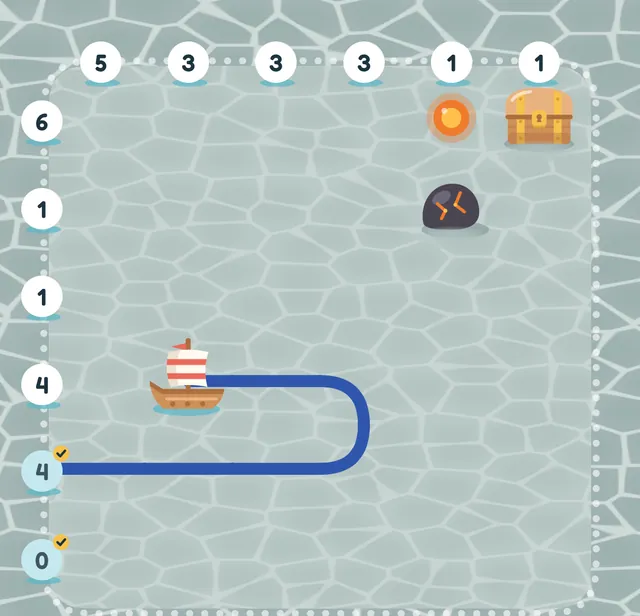
The third world is a dark island of black rock, with a smoking volcano and glowing lava. The water around it is ash grey, and lava rocks, small volcanoes and basalt columns stand in your way.
Streams of lava cross some squares of the board. Your ship can sail across them, but only in a straight line.
The rule
Your route must pass through every lava square, and it must go straight through: in on one side and out on the opposite side, never turning on the lava. A lava square next to the edge or next to a rock often tells you at once which way the route runs.
Tips for this world
- A lava square against the edge of the board can only be crossed along that edge.
- If one side of a lava square is blocked, so is the opposite side, and the route crosses the other way.
- Think of each lava square as a short straight piece of route whose direction you still have to choose: across, or up and down.

The jungle river
30 puzzles, boards of 6 by 6 and 7 by 7 squares
In the fourth world your ship leaves the sea and follows a green river into the jungle. Water lilies float on the surface, logs drift past and a crocodile keeps one eye open. On the map, the islands are grassy hills.
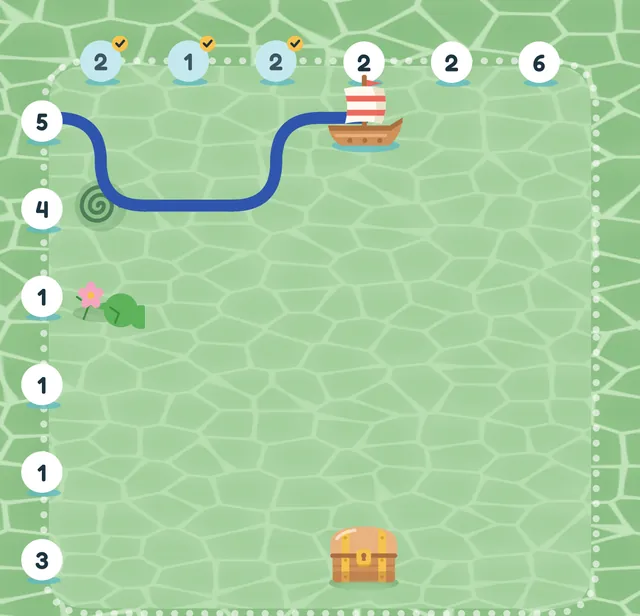
The river hides whirlpools. Wherever one spins, your ship is pulled round a bend.
The rule
Your route must pass through every whirlpool, and it must turn there: it comes in on one side and leaves on a side next to it, never straight across. A whirlpool is the opposite of lava, and together they teach you to read a square by the shape the route takes in it.
Tips for this world
- A whirlpool in a corner of the board has only one way to turn.
- A whirlpool against the edge always connects to the square away from that edge, plus one of its neighbours along the edge.
- Once you know where the route enters a whirlpool, put a cross on the square straight across: the route can never leave that way.

The ghost sea
30 puzzles, boards of 6 by 6 and 7 by 7 squares
The fifth world is a misty purple sea where ghost ships drift and pale lights glow above the water. A rock shaped like a skull marks the island on the map. It is the quietest world, and the most puzzling one.
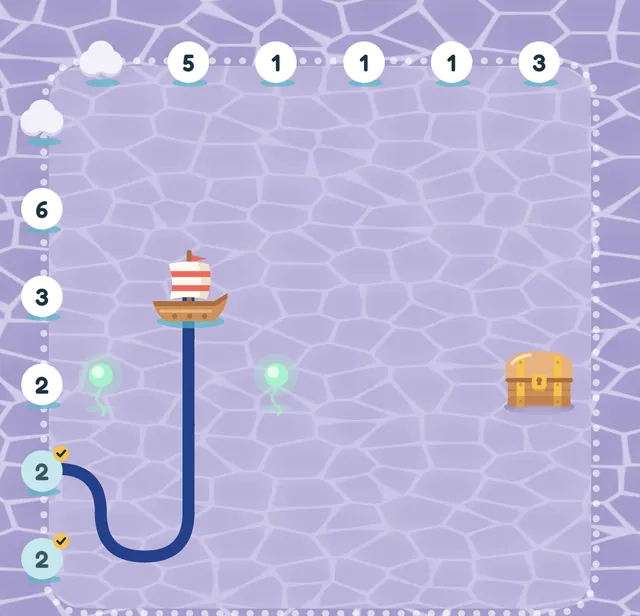
Fog has rolled over the edge of the board, and some of the numbers you have relied on all voyage are hidden under a little cloud.
The rule
One to three numbers on each board are hidden in the fog. The route is still the only one that fits, so the numbers you can see, together with the rocks, the ship, the treasure and the edge, are enough to find it. A number in the fog never counts as a mistake.
Tips for this world
- Every square of the route is counted once in a row and once in a column, so the row numbers add up to the same total as the column numbers. If only one number is hidden, that sum tells you what it is.
- Solve the rows and columns you can see first. The hidden one often falls into place by itself at the end.
- In the fog a cross is worth more than ever, so mark every square you are sure stays empty.


How the worlds open
A world opens once every puzzle in the world before it is solved. Within a world the puzzles open one by one, so there is always a next island waiting on the map. Your progress is saved after every move, even halfway through a board, so you can close the game and later carry on exactly where you stopped.
All five worlds are free. You never have to buy a world, and you can replay any puzzle you have solved without losing a life.
Ready to set sail?
Learn every rule step by step on how to play, or read the common questions.