
How to play
Piradoku
Piradoku follows the rules of Tracks, a logic puzzle loved for its clear rules and satisfying solutions. You do not need to know it already: the game starts with four short practice puzzles, and this page explains everything you meet along the way, from the first board to the fog of the ghost sea.
Piradoku and the train tracks puzzle
Piradoku is a train tracks puzzle at sea. In the newspaper version you lay a single railway line from one edge of the grid to the other, and the numbers count the pieces of track in each row and column. Piradoku plays by exactly the same rules: your ship is the entrance, the treasure is the exit, and the route between them is the track. The frozen pieces of route you meet in the ice sea are the given pieces of track that a classic puzzle starts you with.
The rules of the tracks puzzle
- The board is a square of sea, five to seven squares wide.
- Your ship starts on the left edge of the board. The treasure lies on a fixed square.
- The route runs from square to square: up, down, left or right, never diagonally.
- The route never visits the same square twice.
- The number above each column and to the left of each row says how many squares of that column or row the route uses.
- Rocks, wrecks, tentacles and the other pieces each fill a square. The route cannot pass through them.
- Exactly one route fits. When the ship reaches the treasure and every number fits, the puzzle is solved.
Sailing and marking
Put your finger on the ship and drag. Every square under your finger becomes the next step of the route, and the ship follows with a little bob. To sail back, drag back along your route, or tap a square on your route and the ship returns to it. Sailing back is always free.
Tap any other square of water to put a cross in it. A cross means: the route does not come here. Crosses are your memory on the board, and they make the next step easier to see. Tap the square again to take the cross away.
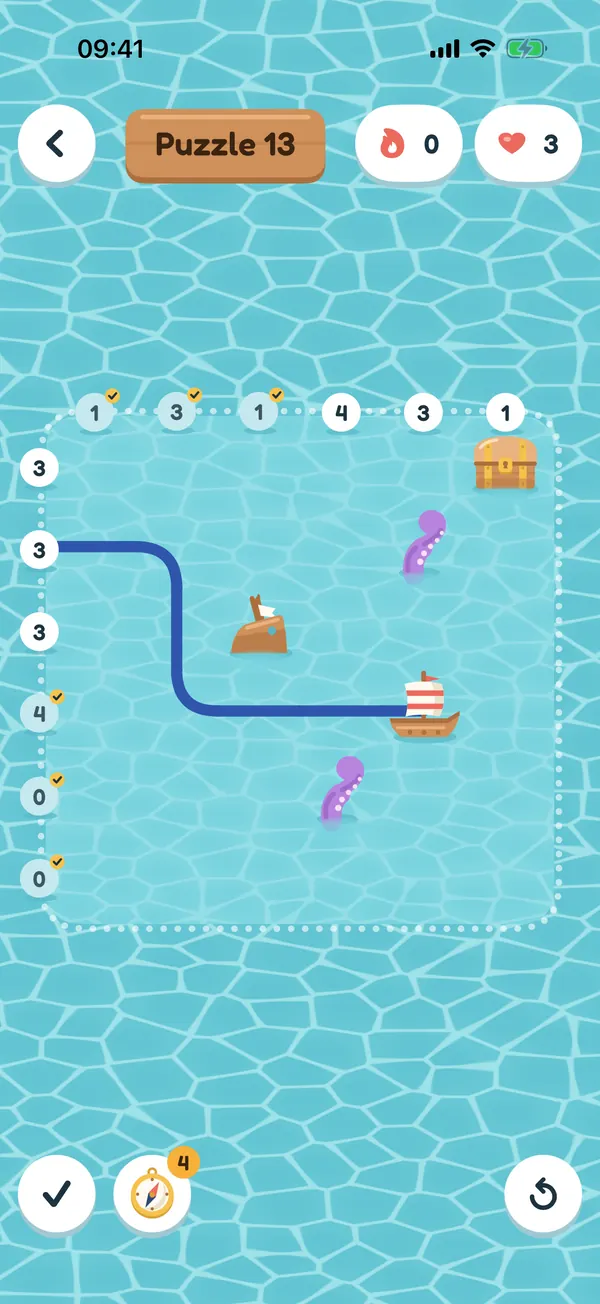
What the numbers tell you
Each number sits on a small disc that changes as you play.
- A white disc: the number is still open.
- A dimmed disc with a gold tick: the route uses exactly that many squares. It fits.
- A red disc with an exclamation mark: the route uses too many squares in that row or column.
Mistakes and lives
You have three lives. A life goes the moment a number gets too many squares. The game shows which number went over, and when you let go your ship sails back to where that move began, so you can try another way. Reaching the treasure while not every number fits costs nothing: your ship simply waits there until you sail back.
Lives come back on their own, one every thirty minutes. One swipe never costs more than one life, however fast you drag. And there is always something to play: replaying a solved puzzle and the puzzle of the day never cost a life.
When you are stuck
Tap the check at any time. It is free, and it shows where your route stopped being right, or a cross that sits where the route does go. It never shows the answer.
A compass lays down one right piece of route or a cross for you, and a piece placed by a compass never costs a life. You get three compasses after the practice puzzles and earn more as you play: one for every ten puzzles you solve, two for every world you finish and one for every puzzle of the day.


Tips to solve any board
Every board can be solved without guessing. These steps help you find a way in.
- Start with the zeros. A row or column with a 0 stays empty. Cross out every square in it.
- Look for full rows. If a number equals the open squares in its row or column, the route uses every one of them.
- Read the ones. A 1 means the route crosses that row in a single square, going straight up or down, unless the ship or the treasure lies in that row. A 1 above a column works the same way, left to right.
- Follow the ends. The route always leaves the ship and always arrives at the treasure. A ship or treasure with only one open neighbour shows you the first or the last step.
- Mind the dead ends. Every square the route passes on the way needs two open neighbours, one to come in and one to go out. A square with only one way out can only be the start or the end.
- Use crosses generously. Every square you rule out narrows the choices around it, and many boards fall into place after a few well placed crosses.
- Check the totals in the fog. The row numbers add up to the same total as the column numbers, because each square of the route is counted once in each. If one number is hidden, subtract.
The puzzle of the day
Every day there is one new board, the same for every player. It works without an internet connection, and a new one starts at midnight. On Monday and Tuesday the board is five squares wide, from Wednesday to Friday six, and at the weekend seven. Solving it gives you a compass and coins, and on consecutive days it builds your streak. Miss a day and the streak starts again.
Rules of the later worlds
Each world after the first adds one rule. In the ice sea, frozen pieces of route show how your ship must pass. On the volcano island, the route crosses every lava square in a straight line. On the jungle river, it turns in every whirlpool. And in the ghost sea, some numbers hide in the fog. Read more about each one on the page about the five worlds.

Still have a question?
The common questions probably answer it, and otherwise write to us.